
This article is part of the local UponAI blog library and focuses on practical AI voice and communications workflow lessons that matter in live business environments.
From the Technology Reseller News podcast
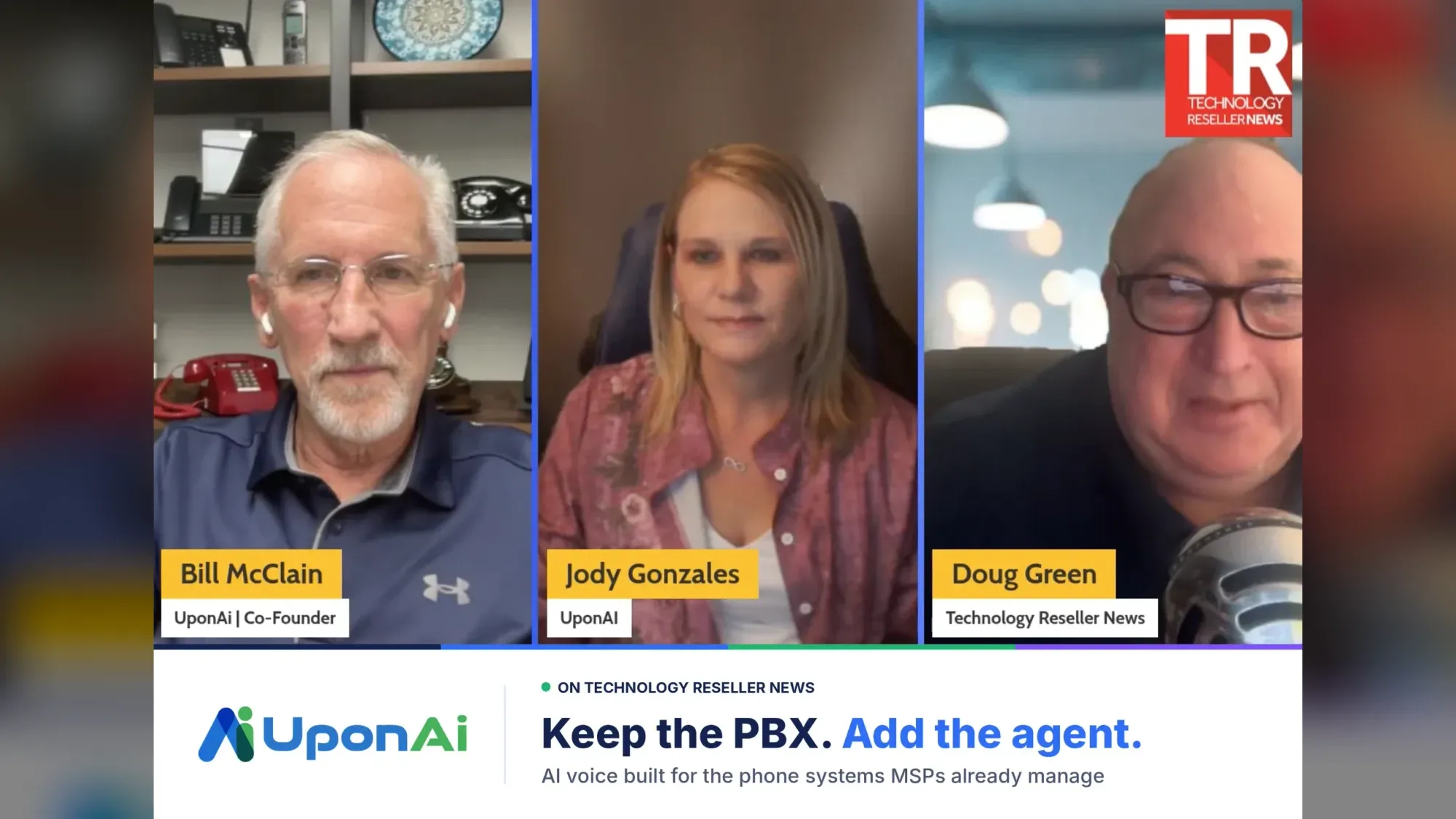
With Bill “Phone Bill” McClain and Jody Gonzales of UponAI. Hosted by Doug Green, publisher of Technology Reseller News.
Per-second
Billing to partners, no rounding up to the minute
BYOT
Agents connect to the PBX through a SIP extension
1,800+
Integration types reported, plus custom API work
10 + 39
Languages: multilingual agent plus transfer agents
4 weeks
Four one-on-one sessions to build the first agent
Plenty of AI voice platforms are built by people who understand language models. Far fewer are built by people who understand SIP extensions, BLF, and the mix of PBXs an MSP inherits after a client merger or a network that grew one project at a time. In a recent conversation with Technology Reseller News publisher Doug Green, UponAI’s Bill McClain and Jody Gonzales agreed on the gap: AI voice people often don’t know telephony. UponAI was built to close it.
Built for partners who look under the hood
UponAI started as something its founders needed for themselves. They deliberately avoided a “click and save” environment, because the people they work with want access to the settings and control over their agents, not a black box someone else manages.
“We put AI tools in the box, we take old ones out, and then we deliver that toolbox to our partners in a fashion where they can build their own agents.”
Bill “Phone Bill” McClain, UponAI
Keep the phone system. Add AI voice.
UponAI is an AI voice platform structured around UCaaS environments and designed to be platform-agnostic. Agents connect to a PBX through a SIP extension, which gives them visibility of internal extensions and lets calls move back and forth between live staff and AI agents.
The model is bring your own telephony (BYOT): partners keep their own phone numbers and voice minutes and use UponAI for the agents. For an MSP, that means AI voice can be sold into a customer’s existing platform, even when the customer has no interest in switching phone systems or handing over telephony.
Per-second billing, partner pricing
Short calls are common, and many providers round a 15-second call up to a full minute. UponAI bills partners by the second for what they actually use. How partners bill their own clients is up to them, which leaves room to build AI voice into existing service plans and margins.
Integrations and white label
UponAI supports API, MCP, and webhook integrations, and the team reports more than 1,800 low-code and no-code integration types across CRMs, accounting systems, and billing platforms. Systems reachable only by API can be handled through custom integrations, which partners can build themselves or have the UponAI team build. The platform is also white-label, so partners can deliver AI voice under their own brand.
Transfers that check the line first
A blind transfer that lands in voicemail defeats the purpose of an AI agent. With BLF monitoring, an UponAI agent can see whether the person is already on the phone. It can also speak with the person receiving the transfer to confirm they’re available, and if they aren’t, bring the call back and route it to someone else.
01
Agent handles the call
Caller asks for a person
02
BLF check
Is the extension already on a call?
03
Confirm availability
Agent speaks with the recipient first
04
Connect or reroute
Unavailable? The call comes back and goes elsewhere
The point, as the team put it, is outcomes: if the caller’s problem isn’t solved, the call wasn’t handled.
In the field
Multilingual · 24/7
JFK Airport pet terminal
Callers reach UponAI from around the world. A multilingual agent fluent in 10 languages, including English, Spanish, French, Portuguese, German and Russian, switches to the caller’s language, and 39 more are available through transfer agents. A caller asking for Turkish, for example, can be passed to a Turkish agent, around the clock. Name and city pronunciation can be tuned too.
Scheduled deployment
Medical office payments
Scheduled at the time of the interview: callers will authenticate their accounts and pay open balances through the AI agent.
Learning to fish
New partners get four one-on-one sessions over four weeks to learn the platform and build their first agent, with the goal of being able to build on their own afterward.
See it on your own stack
AI voice is most useful to the channel when it fits the telephony partners already run. Book a demo with Bill, Jody and UponAI’s channel manager.
Based on a Technology Reseller News interview with Bill McClain and Jody Gonzales of UponAI
What This Means
UponAI content is built around production use, not generic AI positioning. The goal is to help teams understand how routing, call handling, automation, and human handoff behave once the system is part of daily operations.
Related Solutions
Explore Related Reading
26 calls inside UponAI: highlights from AI Contio's hands-on review
An independent Voice AI reviewer built an agent on UponAI from scratch and put it through 26 test calls. Here is what stood out, and the tools that make it possible.
One Number, Every Location: How Pro On Call Unified a Multi-Site Real Estate Client
Pro On Call Technologies gave a multi-location real estate client one phone number, speech-based routing to the right office, and a receptionist that sounds personable rather than robotic. Here is how the deployment came together.
From Voicemail to eBay Sale: After-Hours Calls That Now Close Business
Advanced Hosted Services runs UponAI’s voice agents on its own phones and resells them to customers across 16 states. Here’s what changed.